
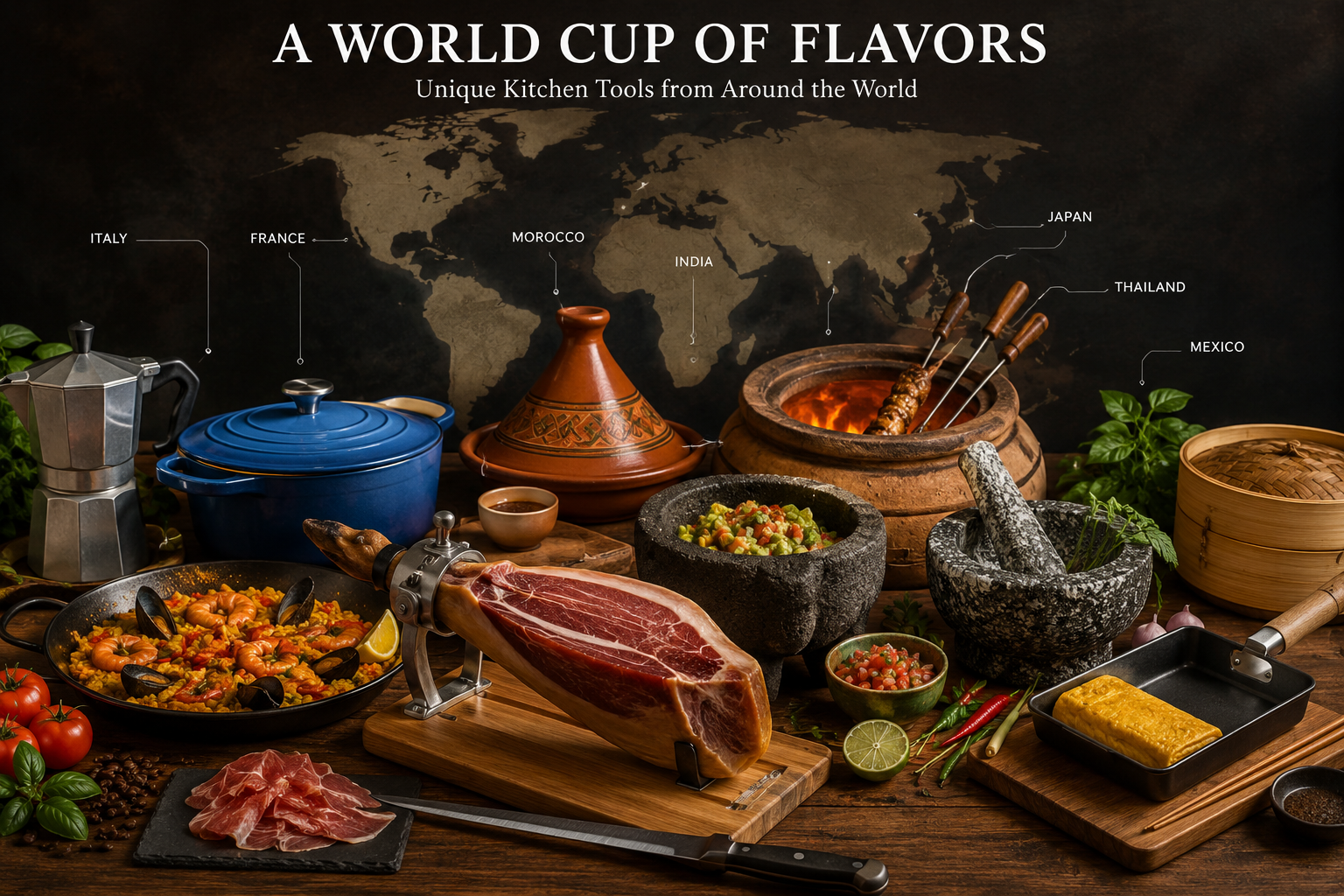
The FIFA World Cup is more than a celebration of football. It is also a celebration of culture, identity, and food. As teams from around the world compete on the field, fans everywhere gather around tables filled with national dishes, family recipes, and regional specialties.

Behind every famous dish, there is often a unique kitchen tool that makes it possible. Chinese stir-fries rely on precision knife work. Japanese tamagoyaki requires a special rectangular pan. Spanish paella depends on a wide, shallow pan that creates the crispy rice layer known as socarrat. Indian tandoori chicken gets its unforgettable smoky aroma from the intense heat of a clay tandoor.
In this article, we explore some of the most iconic kitchen tools and cooking equipment from around the world, and how they help create the flavors that define each country’s cuisine.
China: Chinese Cleavers and Specialized Kitchen Knives

Chinese cooking is deeply connected to knife skills. In many Chinese kitchens, one knife can handle most daily prep work, from slicing vegetables to portioning meat. However, not all Chinese cleavers are the same.
Chinese Slicing Cleaver
The Chinese slicing cleaver is often considered the soul of a Chinese kitchen. It has a thin blade, a straight cutting edge, and a wide rectangular shape. It is designed for up-and-down chopping, push cutting, slicing, shredding, and mincing.
It can be used for vegetables, boneless meat, herbs, tofu, and many general kitchen tasks. However, despite its cleaver-like appearance, it should not be used for cutting through bones.
Bone Chopper
A Chinese bone chopper is much heavier and thicker than a slicing cleaver. It has a wider blade angle and is designed specifically for hard ingredients such as fish bones, chicken bones, ribs, and other tougher cuts.
It is powerful, but it is not suitable for fine vegetable prep or delicate slicing.
Sang Dao
The Sang Dao is thinner and narrower, with a smaller blade angle. It is excellent for delicate slicing, fine shredding, and precise cutting. For chefs who focus on refined knife work, this style of knife offers great control.
Dual-Purpose Chopper
The dual-purpose cleaver, sometimes called a slicing-and-chopping knife, is designed to do both “civil and military” work. The front two-thirds of the blade are used for slicing vegetables and boneless ingredients, while the back third can handle small bones such as fish bones or chicken wings.
However, this type of knife can be difficult to maintain because the front and back sections may have different blade angles. Sharpening it properly requires skill, so it may not be the best choice for beginners.
Japan: Tamagoyaki Pan

The tamagoyaki pan is a rectangular Japanese pan used to make tamagoyaki, a rolled omelet often served in sushi, bento boxes, and traditional Japanese breakfasts.
Tamagoyaki pans are commonly made from copper, tin-lined copper, aluminum, or non-stick materials. Professional chefs often prefer copper because it conducts heat quickly and evenly. This allows the egg mixture to set in a short time, making it easier to roll into soft, even layers.
There are also regional differences. In the Kanto region, tamagoyaki pans are often closer to a square shape. In the Kansai region, they are usually more rectangular. These differences reflect local cooking styles and texture preferences.
For anyone who loves Japanese cuisine, a tamagoyaki pan is more than a specialty tool. It represents the precision, patience, and elegance of Japanese cooking.
France: Enameled Cast Iron Dutch Oven

Few pieces of cookware are as strongly associated with French cooking as the enameled cast iron Dutch oven. It is ideal for slow cooking, braising, stewing, soup making, and oven roasting.
The popularity of enameled cast iron comes from its versatility. It can be used on gas stoves, electric stoves, induction cooktops, and inside the oven. Its heavy cast iron body distributes heat evenly and retains heat extremely well, making it perfect for dishes that require long, gentle cooking.
Compared with clay pots, enameled cast iron often offers better heat retention and more even cooking. The glass-like enamel coating also helps resist acidic ingredients, salt, and moisture, making it easier to clean and safer for many types of cooking.
From beef bourguignon to coq au vin, the French Dutch oven is built for deep flavor, slow transformation, and comfort food at its best.
Spain: Paella Pan

The paella pan is the heart of Spain’s most famous rice dish. A traditional paella pan is wide, shallow, and designed with a large cooking surface. This shape allows the rice to cook in a thin, even layer.
The goal is not just fluffy rice. The true treasure of paella is socarrat, the crispy, golden layer of rice that forms at the bottom of the pan. Carbon steel paella pans are especially valued because they heat quickly and help create this signature texture. Serious Eats notes that a traditional paella pan’s wide, responsive surface is key to developing socarrat.
Most traditional paella pans are made from polished carbon steel or lightweight cast iron. Carbon steel provides fast heat transfer, but it also requires seasoning and proper drying to prevent rust. Many traditional pans are best used over open flame, gas burners, or specialized paella burners.
For authentic Spanish paella, the pan matters just as much as the rice.
Spain: Jamonero and Jamón Knife

Spain has another iconic food tool: the jamonero, or ham stand, paired with a long, flexible jamón knife.
Spanish ham, especially Ibérico and Serrano ham, is traditionally sliced by hand. To do this properly, the ham must be secured firmly on a stand. The slicer then uses a long, narrow, flexible knife to follow the natural grain of the meat.
The goal is to cut slices that are thin, even, and almost translucent. When cut correctly, each slice releases the aroma of acorn-fed pork, cured fat, and aged meat.
A jamón knife is usually around 24 to 30 cm long. Its slim and flexible blade helps carve around the bone and create paper-thin slices with balanced fat distribution. For Spanish ham lovers, the knife and stand are essential parts of the tasting experience.
Italy: Moka Pot

The Moka pot is one of Italy’s most beloved household coffee tools. The iconic Bialetti Moka Express dates back to 1933, when it was invented by Alfonso Bialetti.
A Moka pot has three main parts:
The bottom chamber holds water.
The middle basket holds ground coffee.
The top chamber collects the brewed coffee.
As the water in the lower chamber heats up, pressure builds and pushes the water through the coffee grounds. The brewed coffee then rises into the upper chamber.
The result is a strong, concentrated coffee that is close to espresso in flavor, though it is made without a full espresso machine. For many Italian families, the Moka pot is not just a coffee maker. It is a daily ritual.
Mexico: Molcajete

The molcajete is a traditional Mexican mortar and pestle made from volcanic stone. It has a rough interior surface and is usually paired with a stone pestle called a tejolote.
This tool is essential for making traditional salsa, guacamole, spice pastes, and marinades. Unlike a blender, a molcajete crushes ingredients rather than cutting them. This releases oils, juices, and aromas in a different way, creating a rustic texture and deeper flavor.
Molcajetes are also used as dramatic serving bowls. In some restaurants, a heated volcanic stone bowl is filled with grilled meats, seafood, cheese, peppers, cactus, and rich sauces. The stone retains heat, keeping the dish sizzling at the table.
For Mexican cuisine, the molcajete is both a prep tool and a symbol of tradition.
India: Tandoor

The tandoor is a traditional cylindrical clay oven used across South Asia, Central Asia, Western Asia, and nearby regions. It is heated with charcoal or wood, creating intense direct heat and smoky flavor.
A traditional tandoor can reach temperatures around 480°C, which allows it to cook food extremely quickly. This high heat seals in moisture, chars the outside, and creates the signature smoky aroma of tandoori cooking.
The tandoor is used for dishes such as tandoori chicken, seekh kebabs, naan, roti, and other flatbreads. Naan is slapped onto the inner wall of the oven, where it bakes quickly against the hot clay surface.
Tandoori masala, the spice blend often used with this cooking style, may include turmeric, cumin, cinnamon, cloves, nutmeg, cardamom, chili, black pepper, white pepper, onion, and other aromatic spices. The combination of spices, smoke, heat, and clay creates one of the world’s most recognizable cooking traditions.
Morocco: Tagine

The Moroccan tagine is both a cooking vessel and the name of the dish prepared inside it. It has a shallow base and a tall cone-shaped lid.
The design is simple but clever. As food cooks, steam rises into the cone-shaped lid, condenses, and drips back into the dish. This keeps meat, vegetables, dried fruits, and spices moist during slow cooking.
Tagines are often used for lamb, chicken, preserved lemon, olives, chickpeas, apricots, almonds, and warm spices such as cinnamon, cumin, ginger, and saffron.
The result is tender, aromatic, and deeply layered. Like the French Dutch oven, the tagine is built for slow cooking, but its shape gives it a distinct North African identity.
Korea: Dolsot Stone Bowl

In Korean cuisine, the dolsot is a heavy stone bowl used for dishes such as dolsot bibimbap. The bowl is heated until very hot before rice, vegetables, meat, egg, and gochujang are added.
The heat from the stone continues cooking the rice at the table, creating a crispy golden crust at the bottom. This crunchy rice layer is one of the most loved parts of dolsot bibimbap.
The dolsot is also valued because it retains heat for a long time, keeping food warm throughout the meal. It reflects a key feature of Korean dining: food that continues to change and develop flavor even after it reaches the table.
Thailand: Granite Mortar and Pestle

Thai cooking relies heavily on fresh herbs, chilies, garlic, lime, fish sauce, and spices. One of the most important tools in a Thai kitchen is the granite mortar and pestle.
It is used to pound curry pastes, chili pastes, garlic, herbs, and papaya salad ingredients. Pounding is different from blending. It bruises ingredients, releases essential oils, and creates a more complex texture.
A blender can make a smooth paste, but a mortar and pestle creates depth. That is why many Thai cooks still prefer it for dishes like green curry paste, red curry paste, nam prik, and som tam.
Brazil: Churrasco Skewers
Brazilian barbecue, or churrasco, is known for large cuts of meat cooked over open flame or charcoal. One of the most recognizable tools is the long metal churrasco skewer.
Meat is seasoned simply, often with coarse salt, then cooked slowly over fire. The skewers allow large cuts of beef, pork, chicken, and sausage to be rotated and carved directly at the table.
In Brazilian steakhouses, this serving style is part of the experience. The skewer is not just a cooking tool. It is a symbol of hospitality, sharing, and celebration.
Why Traditional Kitchen Tools Still Matter
Modern kitchens are full of high-speed appliances, digital controls, and multifunction equipment. Yet traditional kitchen tools continue to matter because they are designed around specific foods, textures, and cooking methods.
A paella pan creates socarrat.
A tandoor creates smoky char.
A molcajete creates rustic salsa.
A tamagoyaki pan creates layered omelets.
A Chinese cleaver creates speed and precision.
A Moka pot creates strong Italian-style coffee at home.
These tools show that cookware is not only about convenience. It is about culture, technique, and flavor.
Conclusion
As the World Cup brings countries together through sport, food brings them together through memory, tradition, and taste. Every country has its own cooking tools that tell a story about how people eat, cook, and celebrate.
From the Chinese cleaver to the Japanese tamagoyaki pan, from the French Dutch oven to the Mexican molcajete, these tools remind us that great food often begins with the right equipment.
Whether you are a restaurant owner, home cook, chef, or food lover, exploring international kitchen tools is one of the best ways to understand global cuisine.

At Chefco, we believe every kitchen deserves the right tools to bring authentic flavors to life. From professional knives and cookware to restaurant equipment and specialty kitchen supplies, the right product can turn a simple recipe into a true cultural experience.
