
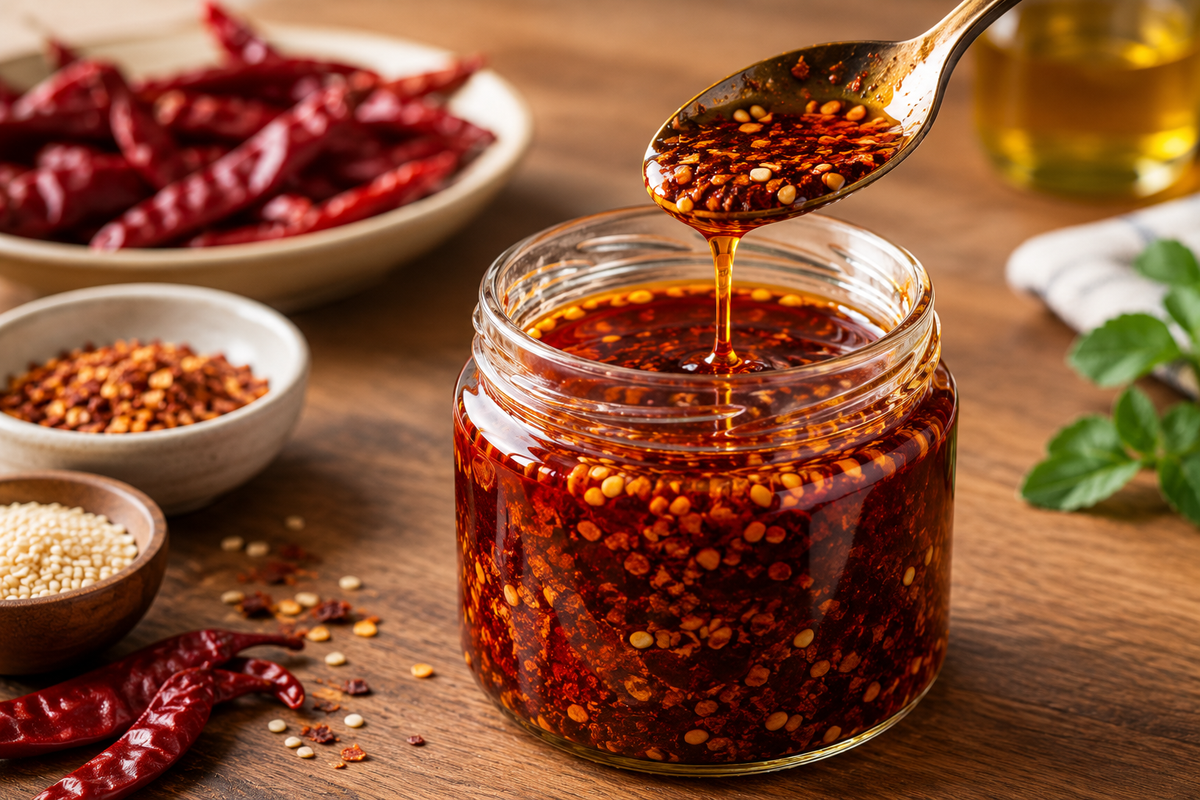

Walk into almost any Chinese restaurant and you may notice a small jar of deep red chili oil sitting beside the soy sauce and vinegar.
It looks fiery. But when you taste it, the first thing you notice often isn't overwhelming heat.
It's the aroma.
Good Chinese restaurant-style chili oil should be fragrant, rich, slightly nutty, beautifully red, and spicy enough to wake up your appetite without overpowering the food. Spoon it over wontons, noodles, dumplings, cold dishes, steamed chicken, or even plain rice, and suddenly the entire dish comes alive.
That balance is what separates a good Chinese chili oil from simply pouring hot oil over the hottest chili powder you can find.
The secret comes down to three things:
the right chilies, the right oil, and the right temperature.
In this guide, we'll show you how to make a classic homemade Chinese red chili oil using the same basic principles found in many Chinese restaurant kitchens.
What Is Chinese Red Chili Oil?
Chinese chili oil is commonly called làjiāo yóu (辣椒油) or, especially in Sichuan cooking, hóng yóu (红油)—literally "red oil."
Unlike modern chili crisp, which may contain large amounts of fried garlic, shallots, peanuts, fermented black beans, or crunchy chili pieces, traditional red chili oil can be surprisingly simple.
At its core, it is an infused oil made with:
-
dried chili flakes or chili powder
-
cooking oil
-
sesame seeds
-
optional Chinese spices and aromatics
The objective isn't necessarily maximum heat.
A well-made red oil should have a clear ruby-red color, toasted chili fragrance, rounded heat, and enough aromatic complexity to work as both a condiment and a cooking ingredient.
Traditional Sichuan versions are strongly associated with roasted rapeseed oil, or caiziyou (菜籽油), which has a nutty, toasted, slightly vegetal character that gives chili oil much more personality than completely neutral oil.
Why Is Chinese Restaurant Chili Oil So Red but Not Extremely Spicy?
This is one of the biggest misconceptions about chili oil.
Redness and spiciness are not the same thing.
Different peppers contribute different things.
Some chilies are prized for heat. Others are prized for fragrance. Some produce an exceptionally deep red color without delivering unbearable spice.
Chinese cooks can therefore blend several varieties instead of relying on one extremely hot pepper.
Think about chili oil as having three separate goals:
| Chili Function | What You Want |
|---|---|
| Color | Deep, clear red |
| Aroma | Fruity, roasted, fragrant |
| Heat | Mild to moderate warmth |
For restaurant-style chili oil, aroma and color are usually more important than extreme heat.
This is why replacing Chinese dried chilies with a bowl full of Thai bird's eye chili powder often produces something spicy—but not necessarily something that tastes like Chinese restaurant red oil.
What Are the Best Chilies for Chinese Chili Oil?
The best chili oil is often made from a blend of peppers rather than a single variety.

Erjingtiao Chili – Best for Aroma
If you can find only one Chinese chili specifically for making red oil, look for:
Erjingtiao (二荆条)
This long Sichuan chili is famous for its strong fragrance, attractive red color, and comparatively balanced heat.
Rather than delivering an immediate aggressive burn, Erjingtiao contributes a deep chili aroma with slightly fruity characteristics, which is one reason it is widely associated with Sichuan chili oil and doubanjiang.
It is an excellent foundation for the type of chili oil we're making here.
Chaotianjiao – For More Heat
Chaotianjiao (朝天椒), or heaven-facing chili, is noticeably hotter.
A small amount blended with Erjingtiao can add heat without allowing the spice level to dominate the entire oil.
For a moderately spicy restaurant-style oil, use it as an accent rather than the main chili.
Zidantou – For Heat and Chili Fragrance
Another Chinese option is Zidantou (子弹头), sometimes translated as bullet-head chili.
It works particularly well when you want more intensity while keeping a recognizably Chinese dried-chili character.
Mild Red Chilies or Paprika – For Color
If your main goal is that brilliant restaurant-style red color, adding a small amount of a mild, pigment-rich dried red pepper can help tremendously.
For home cooks outside China, good alternatives include:
-
mild Chinese dried red peppers
-
Korean red pepper flakes
-
sweet paprika
-
Kashmiri chili powder
They won't taste exactly like Erjingtiao, but they can help you create beautiful color without dramatically increasing the heat.
What About Jalapeño, Poblano, Shishito, Thai Chili, and Chinese Screw Chili?
These are excellent peppers—but they aren't equally suitable for traditional Chinese red chili oil.

Jalapeño
Jalapeños typically provide a bright, green, grassy chili flavor with moderate heat.
They're excellent for salsa, sauces, pickling, and fresh cooking, but they're not usually the first choice for classic Chinese red chili oil, where dried red chilies are preferred.
Poblano and Ancho
Fresh poblano peppers are mild and earthy.
Once dried, they're known as ancho chilies, developing sweeter, deeper flavors.
Ancho can create interesting fusion-style chili oils, but its raisiny, earthy character produces a noticeably different flavor from traditional Chinese red oil.
Shishito
Shishito peppers are generally very mild and are best blistered or stir-fried whole.
They're not particularly useful for producing deep-red chili oil.
Thai Bird's Eye Chili
Thai chilies are small but powerful.
They produce a sharp, fast heat and are excellent in Southeast Asian cuisine.
However, using them as the main chili in Chinese red oil can make the result much hotter than the typical fragrant restaurant-style version we're aiming for.
Use them sparingly if you want additional heat.
Chinese Screw Chili
Chinese screw chilies are recognizable by their long, twisted, wrinkled shape.
Fresh versions are widely available at Chinese and Asian supermarkets and are wonderful for stir-fries because of their crisp texture and moderate heat.
But again, for traditional red chili oil, dried red Chinese chilies such as Erjingtiao are usually the better choice.
The Best Chili Blend for Mild Chinese Restaurant Chili Oil
For a fragrant but manageable heat level, try this combination:
Mild & Fragrant Blend
-
60% Erjingtiao chili flakes
-
25% mild red chili flakes or Korean chili flakes
-
15% Chaotianjiao or another hotter Chinese chili
Can't find Erjingtiao?
Try:
-
50% Korean chili flakes
-
30% regular Chinese dried chili flakes
-
20% paprika
It won't be identical to a Sichuan restaurant's house red oil, but it gives home cooks a very approachable balance of color, fragrance, and heat.
Why Rapeseed Oil Makes Better Chinese Chili Oil
The oil itself is not just a carrier.
It is part of the flavor.
In Sichuan cooking, caiziyou (菜籽油), roasted rapeseed oil, is particularly prized. Compared with highly refined oils, it has a distinctive toasted, nutty and vegetal aroma that pairs especially well with dried chilies.
If you can find Chinese roasted rapeseed oil at an Asian supermarket, it is worth trying.
Otherwise, use:
-
canola oil
-
peanut oil
-
sunflower oil
-
grapeseed oil
A combination of peanut and canola oil also works well when you want some nutty character without making the oil overly heavy.
Homemade Chinese Restaurant-Style Chili Oil Recipe

Ingredients
Chili Base
-
4 tablespoons Chinese chili flakes, preferably Erjingtiao
-
1 tablespoon mild chili flakes or paprika
-
1 tablespoon white sesame seeds
-
½ teaspoon salt
-
¼ teaspoon sugar
Oil
-
1 cup roasted rapeseed oil, canola oil, or peanut oil
Optional Aromatics
-
1 star anise
-
1 small piece cinnamon
-
2 bay leaves
-
2 slices ginger
-
2 pieces scallion
-
a small piece of onion
You can keep the spice mixture very simple.
In fact, if you're trying to recreate the clean red oil served at many noodle shops and dumpling restaurants, using fewer spices is often better.
The chili should remain the star.
The Secret: Pour the Oil Three Times
One of the best techniques for making Chinese chili oil is sometimes described as a three-temperature or three-pour method.
Instead of pouring all the hot oil over the chili at once, the oil is added in several stages.
Why?
Because temperature changes what gets extracted from the chili.
Very hot oil produces toasted aromas.
Moderately hot oil helps develop color and fragrance.
Lower-temperature oil allows the remaining chili flavor to infuse without scorching it.
Similar multi-temperature pouring techniques are used in Sichuan chili-oil preparation.
Step 1: Prepare the Chili Mixture
Place your chili flakes in a large heat-resistant bowl.
Add:
-
white sesame seeds
-
salt
-
sugar
Mix everything together.
Use a bowl significantly larger than you think you need because hot oil will bubble vigorously when it hits the chili.
Step 2: Infuse the Oil
Pour the oil into a wok or saucepan.
Add your optional aromatics:
-
star anise
-
cinnamon
-
bay leaves
-
ginger
-
scallion
-
onion
Heat slowly over medium-low heat.
You aren't trying to deep-fry everything as quickly as possible.
Instead, gently allow the aromatics to release their flavor into the oil.
Once the onions and scallions become golden and the spices smell fragrant, remove all of the solid ingredients.
Now you have your aromatic oil base.
First Pour: Wake Up the Aroma
Approximately 180–200°C / 356–392°F
Let the oil become quite hot.
You may notice the surface beginning to shimmer.
Carefully pour approximately one-third of the oil into the center of the chili mixture.
Immediately you'll hear an aggressive:
Sssssssss!
This is the most dramatic stage.
The high-temperature oil rapidly toasts the chili and sesame, creating the intense roasted fragrance that makes freshly prepared chili oil smell so irresistible.
Stir immediately with chopsticks or a heat-resistant spoon so the chili heats evenly.
The key here is fragrance, not color.
Don't pour all of the oil at this temperature or you risk burning the chili.
Second Pour: Extract the Red Color
Approximately 140–160°C / 284–320°F
Allow the remaining oil to cool slightly.
Pour another third slowly around the edge of the bowl.
This pour should sound noticeably calmer.
Now watch what happens.
The oil begins changing into a gorgeous clear red.
This middle-temperature stage is especially important because you are extracting pigments and chili aroma without aggressively scorching the flakes.
This is where the chili oil begins looking like hong you—true red oil.
Third Pour: Bring the Flavors Together
Approximately 110–130°C / 230–266°F
Let the remaining oil cool further.
Pour the final third into the bowl.
There should be much less sizzling now.
At this temperature, you're no longer trying to aggressively fry the chili.
You're allowing the remaining aromas, heat and oil-soluble compounds to combine gently.
Give everything a final stir.
You'll already have good chili oil.
But it's not finished yet.
Let Your Chili Oil Rest
Freshly poured chili oil smells wonderful, but the flavor becomes noticeably more harmonious after resting.
Let the container cool completely.
Then cover it.
For the best flavor, give the chili and oil time to infuse before using it heavily.
Around 12–24 hours is an excellent starting point.
The next day you'll notice that the oil is often:
-
darker
-
clearer
-
more aromatic
-
more rounded
-
less harsh
The chili sediment settles toward the bottom while a clear layer of brilliant red oil rises above it.
That's exactly what you're looking for.
Important Food Safety Note
Homemade infused oils need to be handled carefully.
If your chili oil contains fresh garlic, fresh herbs, scallions, ginger, or other low-acid fresh ingredients left inside the oil, it should not simply be stored indefinitely at room temperature.
Oil creates a low-oxygen environment, and improperly stored garlic- or herb-infused oils can present a botulism risk. Food-safety guidance recommends refrigeration for homemade chili oils and similar oil-based products containing these ingredients.
For this recipe, it is better to remove the fresh aromatics after infusing the oil.
Once cooled, keep homemade chili oil covered and refrigerated, especially if any fresh ingredients remain in the finished product.
Always use a clean, dry spoon when serving.
How Chinese Restaurants Make Chili Oil More Fragrant Without Making It Hotter
Here's the most useful lesson from restaurant kitchens:
Don't add more hot chili. Add more layers of aroma.
There are several ways to accomplish this.
Toast the Dried Chilies
Lightly toasting dried chilies before grinding them develops a deeper roasted fragrance.
Just be careful.
Dark brown chili is already too far.
You want the peppers fragrant and slightly crisp—not burnt.
Traditional Sichuan techniques also use toasted chilies for additional aroma before crushing them.
Use Coarse Chili Flakes
Fine chili powder burns very easily.
For most homemade red oil, a mixture of:
-
coarse chili flakes
-
medium chili flakes
-
a small amount of fine chili powder
works better.
The coarse flakes contribute aroma and texture while the finer particles release color quickly.
Add White Sesame
Sesame doesn't add heat.
But once hot oil hits it, the seeds release a wonderful toasted fragrance that gives Chinese chili oil much of its familiar restaurant character.
Use a Small Amount of Sugar
The objective isn't to make chili oil sweet.
A tiny amount of sugar rounds out bitterness and makes the chili taste fuller.
Think of it as seasoning rather than sweetness.
Restaurant-Style Aromatic Chili Oil
If you're looking for a slightly more complex version suitable for noodles, wontons, dumplings, cold dishes and dipping sauces, try this formula.
Ingredients
-
50 g Erjingtiao chili flakes
-
20 g mild red chili flakes
-
10 g hotter Chinese chili flakes
-
15 g toasted white sesame
-
400–500 ml roasted rapeseed oil
-
½ onion
-
2 scallions
-
4 slices ginger
-
2 star anise
-
1 small cinnamon stick
-
2 bay leaves
Slowly infuse the aromatics into the oil.
Remove them.
Then apply the same three-pour technique.
This produces a deeper, more complex red oil that's particularly good for:
-
wontons in chili oil
-
dan dan noodles
-
beef noodles
-
dumpling dipping sauce
-
cucumber salad
-
shredded chicken
-
cold noodles
-
hotpot dipping sauces
Sichuan Cold-Dish Chili Oil
Chinese cold dishes demand a slightly different chili oil.
Because the oil isn't competing with intense wok heat, it needs especially good aroma.
Try a blend based around:
Erjingtiao for fragrance + a hotter Chinese chili for heat + mild red chili for color.
You can also add a very small amount of Sichuan peppercorn to the infused oil.
Red Sichuan peppercorn gives a warm citrusy fragrance.
Green Sichuan peppercorn is more floral and typically produces a stronger numbing sensation, so use it sparingly unless you're deliberately making a mala-style chili oil.
Chili Oil vs. Chili Crisp: What's the Difference?
Although the terms are sometimes used interchangeably outside China, they aren't exactly the same thing.
Chinese Red Chili Oil
Focuses on:
-
clear red oil
-
chili aroma
-
controlled heat
-
versatile seasoning
Chili Crisp
Usually emphasizes:
-
crunchy chili solids
-
fried garlic
-
shallots
-
peanuts or soybeans
-
fermented ingredients
-
strong texture
If you're recreating the red oil served with Chinese restaurant noodles, dumplings or cold dishes, red chili oil is probably what you're looking for—not chili crisp.
How to Use Chinese Chili Oil
Once you have a jar in the refrigerator, you'll probably discover that it disappears surprisingly quickly.

Try it with:
Wontons
Mix chili oil with:
-
Chinese black vinegar
-
light soy sauce
-
garlic
-
sesame oil
-
a pinch of sugar
Pour over boiled wontons.
Noodles
Add chili oil to noodle soup or mix it directly into dry noodles with soy sauce and vinegar.
Dumplings
Mix chili oil with black vinegar for an easy dumpling dipping sauce.
Chinese Cold Cucumber Salad
Combine chili oil with smashed cucumber, garlic, black vinegar and soy sauce.
Hotpot
Add a spoonful to your personal dipping sauce.
Fried Rice
A small spoonful added right before serving gives fried rice color and fragrance without turning it into an aggressively spicy dish.
Steamed Chicken
Chili oil is one of the foundations of many Sichuan cold chicken preparations.
Common Chili Oil Mistakes
Mistake #1: Using the Hottest Chili Available
More heat doesn't automatically mean better chili oil.
For Chinese restaurant-style oil, prioritize aroma and color first, heat second.
Mistake #2: Pouring All the Oil at Maximum Heat
Extremely hot oil may smell impressive for a few seconds, but it can quickly burn the chili.
Burnt chili creates:
-
dark brown oil
-
bitter flavors
-
dull aroma
Use several pours instead.
Mistake #3: Grinding the Chili Too Fine
Extremely fine chili powder burns rapidly.
A slightly coarse grind is much more forgiving.
Mistake #4: Using Flavorless Ingredients
When a recipe contains only a handful of ingredients, ingredient quality becomes especially noticeable.
Fresh, fragrant dried chilies make a dramatic difference.
Mistake #5: Using Too Many Spices
Star anise, cinnamon, bay leaves, cardamom, fennel and cloves can all work.
But chili oil isn't five-spice oil.
Too many spices can overwhelm the chili.
For a versatile restaurant-style version, keep things restrained.
FAQ About Homemade Chinese Chili Oil
Why Isn't My Chili Oil Red?
The most common reason is your chili.
Some chili varieties simply don't contain enough red pigment to create brilliant red oil.
Try blending your chili with:
-
Erjingtiao
-
mild Chinese red chilies
-
Korean chili flakes
-
paprika
Also avoid scorching the chili with excessively hot oil.
Why Does My Chili Oil Taste Bitter?
Usually because the chili flakes or spices burned.
If the flakes immediately turn dark brown when you pour the oil over them, your oil is too hot.
How Do I Make Chili Oil Less Spicy?
Use fewer high-heat peppers and more aromatic, lower-heat red chilies.
For example:
More Erjingtiao + mild red chili, less Chaotianjiao or bird's eye chili.
You can also increase the ratio of oil to chili.
How Do I Make Chili Oil More Fragrant?
Try:
-
roasted rapeseed oil
-
Erjingtiao chili
-
toasted sesame
-
gently infused onion, scallion and ginger
-
lightly toasted dried chilies
-
the three-temperature oil method
These increase fragrance without dramatically increasing heat.
Can I Use Canola Oil?
Yes.
Canola oil works perfectly well.
However, traditional Chinese roasted rapeseed oil has a stronger nutty and toasted aroma, so the finished chili oil will taste noticeably different.
Can I Use Olive Oil?
Technically yes, but it isn't recommended for this style.
Extra virgin olive oil has its own distinctive aroma, which competes with the Chinese chili and spices.
Neutral vegetable oil or rapeseed oil works much better.
Should Chili Oil Have Sediment?
Absolutely.
That layer of chili flakes at the bottom contains tremendous flavor.
For wontons and cold dishes, Chinese cooks may sometimes spoon out mostly the clear red oil.
For noodles or dipping sauces, you can stir everything together and scoop up both oil and chili sediment.
The Real Secret to Great Chinese Chili Oil
The best Chinese chili oil isn't a contest to see how much capsaicin you can tolerate.
It's about balance.
You want the fragrance of toasted chili to reach your nose before the heat reaches your tongue.
You want the oil to glow deep red without tasting burnt.
You want sesame, rapeseed oil and spices supporting the chili rather than covering it.
Most importantly, you want something versatile enough that a spoonful improves dumplings, noodles, vegetables and cold dishes instead of making every dish taste exactly the same.
That is why the red chili oil found in a good Chinese restaurant may look intimidating but taste surprisingly approachable.
Red doesn't always mean extremely hot.
Sometimes it simply means the cook understood how to get the most aroma, color and flavor out of the chili.
And once you've learned how to control your chilies, oil and temperature, that restaurant-style red oil is surprisingly easy to make at home.
For home cooks and restaurant professionals preparing chili oil, sauces, dumplings, noodles and other Chinese dishes, having the right cookware and kitchen tools makes the process much easier. From stainless-steel mixing bowls and strainers to woks, saucepans, thermometers and commercial kitchen supplies, Chefco Kitchen & Restaurant Supplies carries practical equipment for both home kitchens and professional foodservice operations.
