
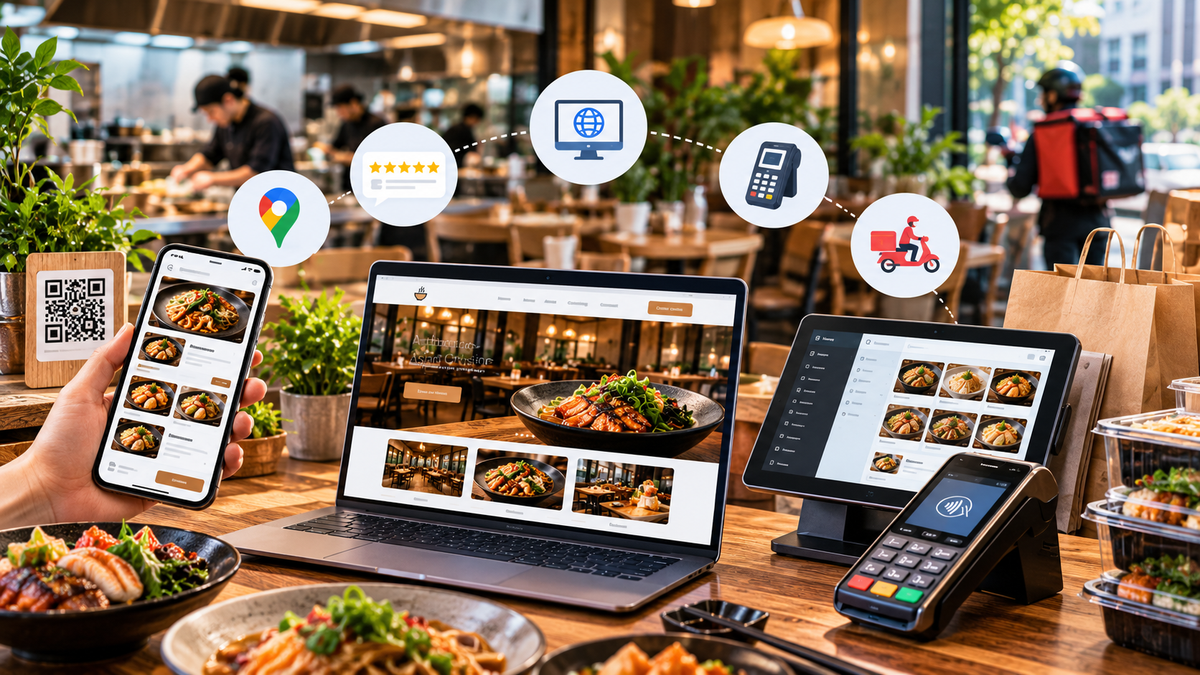
Running a small restaurant has never been easy. Between rising food costs, staffing challenges, delivery commissions, and increasing competition, restaurant owners often find themselves working longer hours just to maintain their business.

But technology is changing the game.
In 2026, artificial intelligence (AI) and digital platforms are no longer tools reserved for large restaurant chains. Even a small family-owned restaurant can automate ordering, improve local marketing, build a professional website, and manage daily operations with a relatively modest budget.
The goal isn't to replace hospitality with technology. It's to spend less time on repetitive tasks and more time serving customers.
Here are seven practical ways small restaurants can upgrade their businesses in the AI era.
1. Upgrade Your Ordering System with QR Codes and Online Ordering

One of the easiest upgrades for a small restaurant is replacing parts of the traditional ordering process with a digital system.
Instead of waiting for a server to bring a menu and take an order, customers can scan a QR code, browse the menu on their phones, and place orders directly.
Platforms such as Snappy offer restaurant-focused solutions that include QR code ordering, online ordering, and POS integration.
For a busy restaurant, this can mean:
-
Fewer routine order-taking tasks for staff.
-
Faster ordering during peak hours.
-
Reduced communication errors between customers and the kitchen.
-
More opportunities to display add-ons, combos, and special offers.
Another often-overlooked area is the waiting list.
Rather than having an employee manually write down names and call guests, restaurants can use digital waitlist systems that send notifications when tables become available.
Snappy offers QR code waitlist functionality, while Reserve with Google allows customers to join supported restaurant waitlists through Google Search or Maps. Google's waitlist feature requires integration with an eligible third-party provider.
For smaller teams, even automating one or two of these processes can make daily operations more manageable.
A practical tip: Don't eliminate traditional menus entirely. Some guests still prefer speaking with staff, and a good digital system should make dining more convenient without making it less personal.
2. Use AI to Market Your Restaurant Without Hiring a Full Marketing Team
Marketing used to require a dedicated employee, an agency, or hours of work after closing.
Today, AI tools such as ChatGPT can help restaurant owners brainstorm campaigns, draft promotional content, translate menus, and research local marketing opportunities.
The first step is understanding where your customers are looking for restaurants.
For example:
-
Google Maps and Yelp: Help nearby customers discover restaurants and read reviews.
-
Instagram and TikTok: Useful for food photography, short cooking videos, and daily specials.
-
Xiaohongshu (RED): Worth considering for restaurants targeting Chinese-speaking customers.
-
Tripadvisor: Particularly relevant for restaurants in tourist-heavy areas.
-
Reddit: Local communities where people discuss restaurants, neighborhoods, and dining recommendations.
AI can help tailor content for each platform rather than publishing exactly the same advertisement everywhere.
For example, a restaurant could turn a single new menu item into an Instagram caption, a short TikTok video script, and a bilingual Xiaohongshu post.
It can also help owners identify local food bloggers, neighborhood events, and relevant online discussions.
However, promotion should feel authentic. Reddit communities, in particular, have rules against spam and manipulative self-promotion. Restaurant owners should participate transparently, answer relevant questions, and avoid flooding discussions with advertisements.
AI is best used as a marketing assistant, not a replacement for genuine community engagement.
A practical tip: Start with two platforms where your customers are most active. Posting consistently on two channels is often more manageable than maintaining six inactive accounts.
3. Work with Delivery Apps, but Protect Your Profit Margins
For many small restaurants, delivery platforms are an important source of additional orders.
In Canada, restaurants can explore services such as Uber Eats, SkipTheDishes, Fantuan, and HungryPanda, depending on their location and target audience.
These platforms can introduce a restaurant to customers who might never discover it otherwise.
The challenge is profitability.
Delivery commissions, promotional discounts, packaging, and food costs can consume a significant portion of each sale. More orders do not automatically mean more profit.
A smarter approach is to treat delivery platforms as customer acquisition channels while developing a separate direct-ordering business.
Restaurants can experiment with platform-exclusive meal bundles, lunch specials, family combos, or limited-time offers. These promotions should be designed around products with healthy contribution margins.
Consider a simplified example:

Illustrative figures only. Actual fees, taxes, promotions, delivery expenses, and contract terms vary.
A delivery app may still be valuable if it brings in genuinely new customers or additional orders during slow periods.
The key is knowing what each channel contributes.
Restaurants can encourage repeat business through their own website, branded packaging, and a loyalty program, while respecting each delivery platform's terms and applicable marketing laws.
A practical tip: Review delivery sales every month. Identify best-selling items, profitable bundles, and promotions that generate revenue without sacrificing too much margin.
4. Build Your Own Restaurant Website with AI
 A professional restaurant website once required a developer or design agency. Today, building a basic website is much more accessible.
Platforms such as Wix offer restaurant website templates, online menus, ordering features, and built-in marketing tools.
Restaurants can also register a domain through providers such as GoDaddy and use AI-assisted website-building tools to create a custom design.
Even someone with little technical experience can use AI to help draft website copy, organize menu categories, write FAQs, and develop a basic site structure.
At minimum, a restaurant website should include:
-
A mobile-friendly menu with clear prices.
-
Address, business hours, and contact information.
-
Online ordering or reservation links.
-
Photos of signature dishes.
-
Links to Google Maps and social media.
-
Information about catering, dietary options, and special services when relevant.
For restaurants with technical knowledge, AI can also assist in writing HTML, CSS, JavaScript, or other code for a more customized website.
However, running a website still requires proper hosting, security, maintenance, and reliable integrations.
One major advantage of owning a website is having a direct relationship with customers instead of relying entirely on third-party marketplaces.
It also creates opportunities for local SEO.
For example, a Thai restaurant in Toronto might develop helpful pages targeting searches such as "Thai takeout in North York" or "Thai lunch near Yonge Street," provided those pages contain useful, accurate information.
A practical tip: Launch a simple, mobile-friendly website first. An accurate menu and working order button are more useful than an impressive design that is difficult to navigate.
5. Choose a Smarter POS and Payment System
 An outdated point-of-sale system can slow down service, complicate accounting, and make it harder to understand business performance.
Modern restaurant POS systems can connect orders, payments, menu information, and sales reports in one place.
Solutions such as Clover and Shift4 are worth evaluating, especially for restaurants looking to combine payment processing with restaurant management features.
Before choosing a provider, compare more than the hardware price.
Look at payment processing fees, monthly subscriptions, contract requirements, online ordering capabilities, kitchen printer integration, reporting tools, and customer support.
For restaurants with some programming experience, AI creates another opportunity: building a customized online ordering interface.
Developers can use supported payment and order APIs to connect a restaurant website with compatible systems. Clover, for example, provides APIs for managing orders and processing online payments.
But building your own ordering interface does not eliminate payment processing fees. It can also introduce development costs, maintenance responsibilities, and security risks.
A custom solution makes sense only when the business has a clear need that existing software cannot satisfy economically.
For most small restaurants, a reliable, ready-made POS system will be a better starting point.
A practical tip: Choose systems that work together. Managing separate, disconnected order channels can create more work than the technology saves.
6. Take Google Reviews and Local SEO Seriously
 For small restaurants, one of the most valuable marketing tools is also free: Google Business Profile.
When someone searches for "restaurants near me" or "best sushi in Mississauga," Google may display nearby businesses before traditional website results.
According to Google, local rankings are mainly influenced by three factors: relevance, distance, and prominence.
Reviews and positive ratings can contribute to a restaurant's prominence, making genuine customer feedback an important part of local marketing.
Start by making sure your Google Business Profile includes accurate hours, contact information, menu links, categories, and high-quality photos.
Then build a consistent review strategy.
Restaurants can encourage customers to share honest feedback by making their review link easy to find, such as on a receipt or a small QR code sign.
AI can also help draft polite, personalized responses to reviews, including complaints.
For example, instead of ignoring a negative review about slow service, a restaurant can acknowledge the experience, explain that the feedback has been shared with the team, and invite the customer to contact management.
Avoid offering discounts, free food, or other rewards in exchange for Google reviews. Google prohibits incentivized reviews and attempts to manipulate ratings.
And remember, there is no guaranteed shortcut to the top of Google Maps.
A strong local presence comes from accurate information, genuine reviews, relevant website content, and consistent customer experiences.
A practical tip: Set aside 15 minutes every week to respond to reviews and check that your Google Business Profile is accurate.
7. Go Beyond Marketing: Use AI for Inventory, Menu Planning, and Customer Retention
Getting more customers is important, but improving efficiency can be just as valuable.
Many small restaurants already collect useful information through POS systems, spreadsheets, inventory records, and online orders. The problem is that this data often goes unused.
AI can help owners analyze sales exports, identify ordering patterns, compare menu performance, and estimate ingredient needs.
For example, a restaurant might discover that certain dishes sell well on weekends but generate weak margins after food preparation costs are considered.
That information can support better purchasing decisions, menu adjustments, and staffing plans.
AI can also help with demand forecasting, although its predictions should be checked against real sales history, holidays, weather, and local events.
Another opportunity is customer retention.
Instead of continuously paying to attract new customers, restaurants can create loyalty programs, birthday offers, and direct-order promotions that give guests a reason to return.
For Canadian restaurants using promotional emails or text messages, marketing communications must comply with Canada's Anti-Spam Legislation (CASL), including applicable consent, identification, and unsubscribe requirements.
The most useful automation is not necessarily the most complicated.
A weekly sales report, low-stock reminder, or automated order confirmation may deliver more practical value than an expensive AI system that employees rarely use.
Where Should a Small Restaurant Start?
Not every restaurant needs to upgrade everything at once.
For owners working with a limited budget, the following roadmap provides a practical starting point.

The order will depend on the restaurant. A busy dine-in location may benefit most from QR code ordering and automated waitlists, while a takeout restaurant may prioritize online ordering and delivery operations.
Before paying for a new service, owners should ask a simple question: Will this tool save time, reduce costs, increase profitable orders, or improve the customer experience?
If the answer is unclear, start with a small trial and measure the results.
Final Thoughts: Small Restaurants Can Compete Smarter in the AI Era
Artificial intelligence won't turn every small restaurant into a successful business overnight.
Great food, consistent service, and a strong reputation still matter more than any piece of software.
What AI can do is make modern business tools accessible to owners who previously lacked the time, money, or technical skills to use them.
From QR code ordering and automated waitlists to local marketing, websites, and inventory analysis, small restaurants now have more ways to operate efficiently and reach new customers.
The smartest approach is to start small, choose tools that solve real problems, and measure whether each upgrade actually improves the business.
